


By Aaron Selkow, Owner/Director
I was going through my closet at home the other day.
It was one of those projects that lingers — not because it’s complicated, but because it’s personal. Ann knew that. She was patient and encouraging, understanding that cleaning out my closet wasn’t just about making space. It was about deciding what parts of my past I was ready to hold differently.
We’ve lived in this house for about twenty years. I’ve spent thirty-three years in camp leadership. And if I really count it all — as a camper, a staff member, and a professional — I’m closing in on fifty summers at camp. That’s a lot of living. And, as it turns out, a lot of T-shirts.
Camp-branded clothing accumulates quietly. Year by year. Summer by summer. Before you know it, you’re standing in front of shelves filled with fabric memories: staff shirts, leadership gear, so many hats, apparel tied to traditions, themes, moments that once felt all-consuming and now live somewhere deeper.
Over the years, I’ve tried to be intentional. When I left Pinemere Camp — the camp where I grew up as a child and later served as director for many years — I gave away shirts and sweatshirts so they could keep being used. I did the same when I left Camp Harlam after nine years as a leader. And once I leave a camp, I stop wearing those shirts entirely. It wouldn’t feel right for me, as the director of Chestnut Lake Camp, to be running errands or standing on the sidelines at a soccer game in apparel from another chapter of my professional life.
Still, I kept more than I needed.
And when I finally sorted through what remained, I noticed something interesting — not just what I kept, but what I didn’t.
Some shirts didn’t make the cut because, frankly, they don’t hold up. Designs that felt clever at the time now make me cringe. Graphics that, looking back, border on inappropriate. Slogans that were well-intentioned but poorly thought through. A few that would probably make an intellectual property attorney pause at my willingness to “borrow” inspiration without fully thinking through the implications.
Those shirts are part of my story, too. They reflect mistakes. Blind spots. A younger version of myself still learning — sometimes clumsily — how creativity, humor, leadership, and responsibility intersect. I didn’t keep them because growth means recognizing that not everything deserves to be preserved in the same way.
What struck me most, though, was how worn the shirts I did keep were. These weren’t pristine keepsakes. They were faded. Softened. Stretched. Stained in places I couldn’t quite identify anymore. They had lived camp alongside me — through long days and longer nights, unexpected rainstorms, high-energy moments, quiet conversations, staff meetings, campfires, and the thousands of ordinary moments that turn out not to be ordinary at all.
In that way, the shirts didn’t just represent camp. They experienced it.
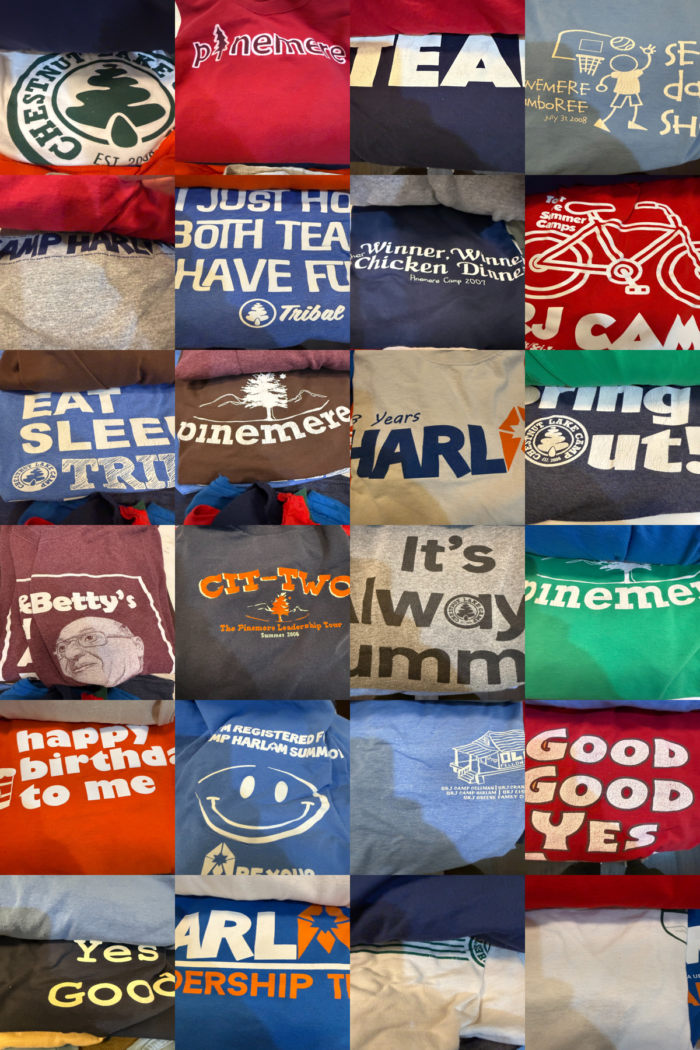
After everything was sorted, folded, and set aside, I looked at the shirts that remained and realized I wanted to do something with them — something more meaningful than putting them back on a shelf. I decided to have several of them made into a quilt. The quilt will include 24 shirts from all three camps I’ve led. Different colors. Different eras. Different design styles. Nearly all of them shirts I designed myself, which has always been one of my favorite creative outlets. Each one tied to a particular moment, group of people, or unique camp season.
Lying them out together, they felt less like memorabilia and more like relationships.
Some were joyful and easy. Some were complicated. Some belonged to chapters that shaped me profoundly, even when I didn’t realize it at the time. They don’t all match. They weren’t meant to. But stitched together, they tell a coherent story — not of perfection, but of commitment, evolution, and care.
There’s a line often attributed to Maya Angelou: “Do the best you can until you know better. Then when you know better, do better.” That feels right here. Camp — at its best — gives us the space to do exactly that. To try ideas. To build traditions. To learn from missteps. To grow alongside the people who we’re leading. When the quilt is finished, it will tell a story. Not neatly. Not chronologically. But honestly. And camp works the same way.
What campers take home from Chestnut Lake won’t be a quilt. But it will be something stitched together quietly over time: friendships, confidence, independence, resilience, lessons learned through both success and struggle. Pieces that may not fully make sense on their own, but together form something strong, warm, and lasting.
Fifty summers later, that’s what I see when I look at these shirts — both the ones that made the quilt and the ones that didn’t.
A life shaped by camp.
Worn in.
Learned from.
And still growing.
Leave a Reply